Overview: A Balanced Duality.
These are two Chinese narrative paintings, executed in ink and colour on silk. Based on the inscriptions, they date to the spring of 1900 (Late Qing Dynasty).
They appear to be designed as a conceptual pair, representing a balance of opposing forces
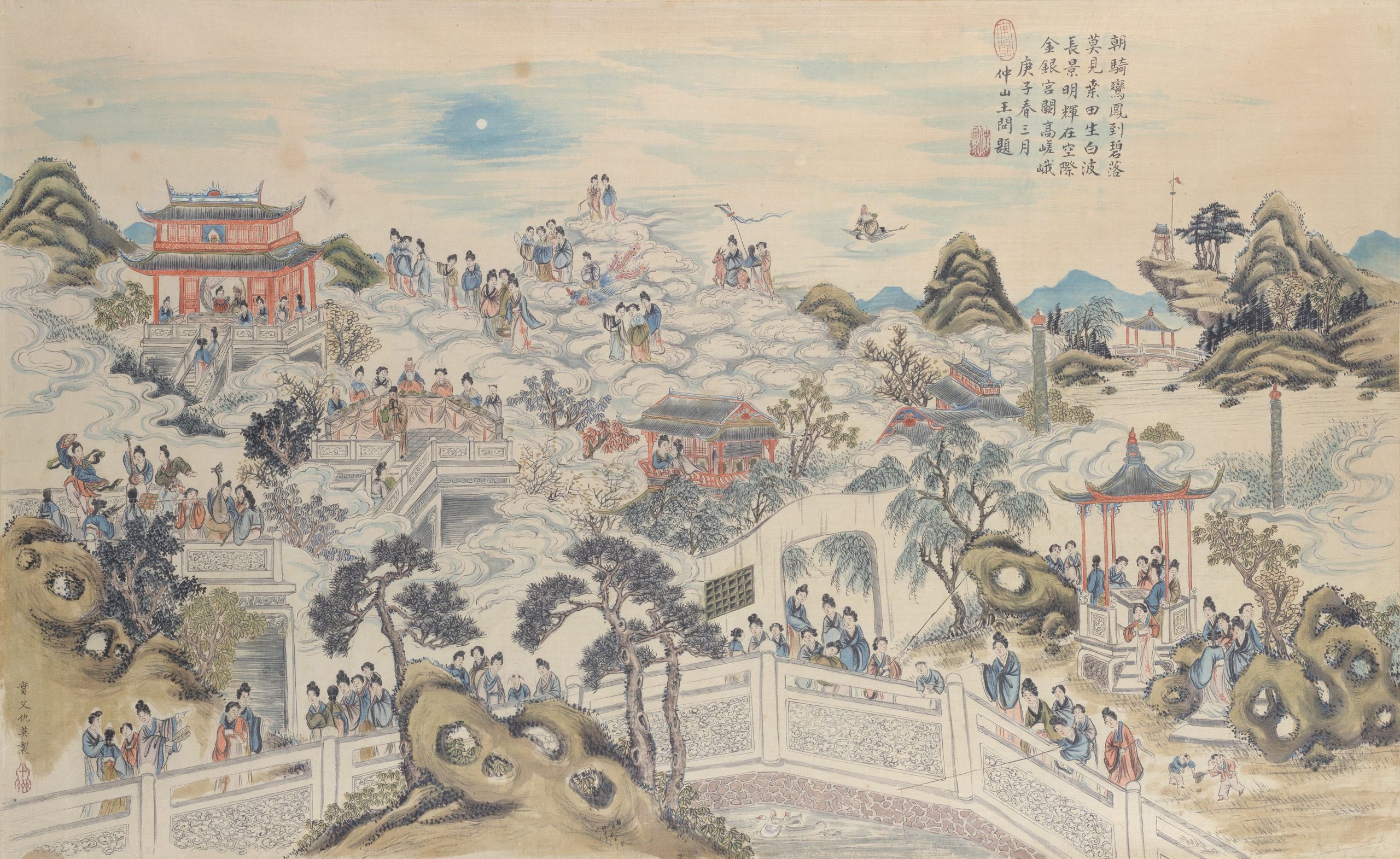
- The Celestial Scene: Represents the Heavenly Realm, spiritual transcendence, mythology, and “Yin” (feminine) energy.
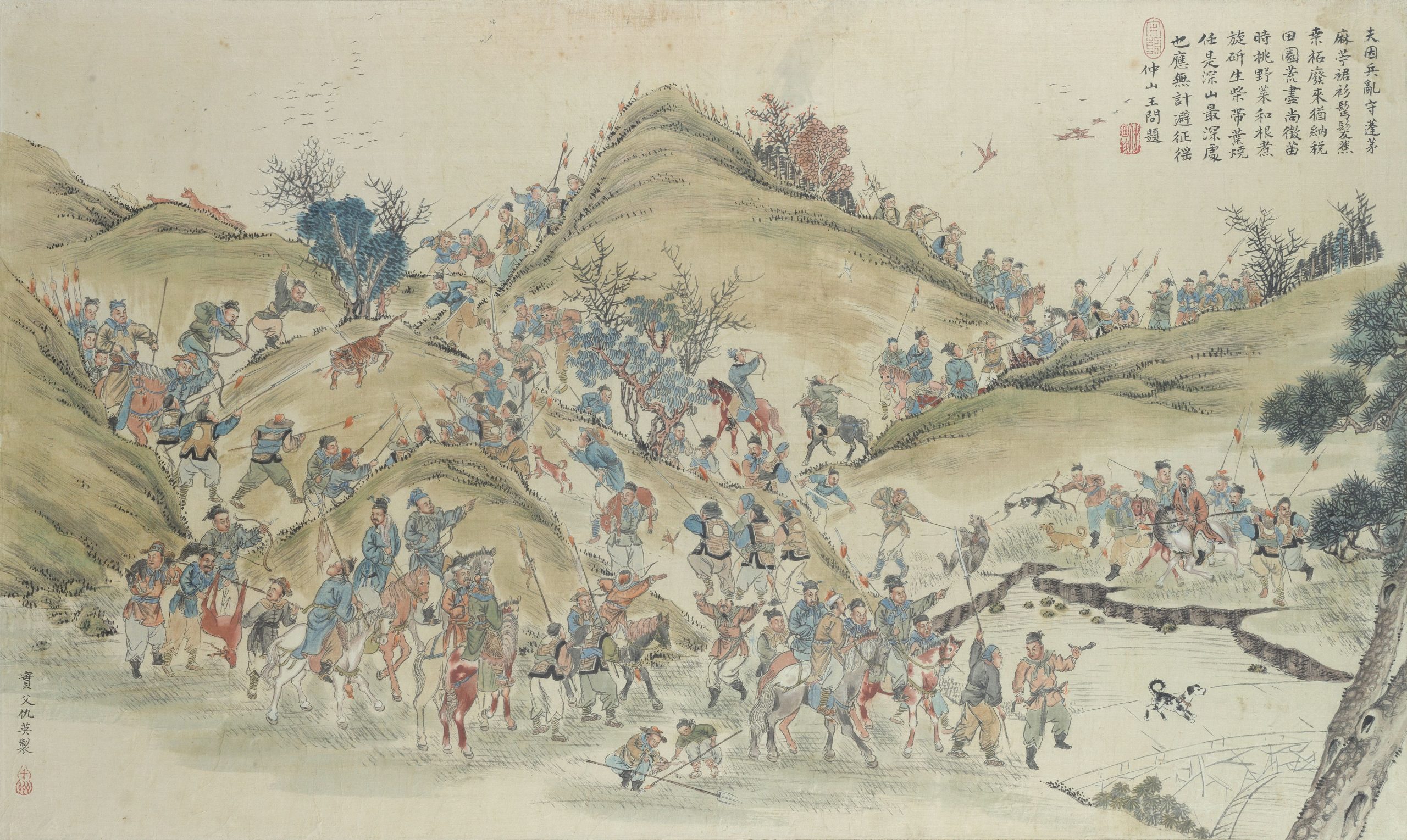
- The Hunting Scene: Represents the Earthly Realm, physical prowess, military might, and “Yang” (masculine) energy.
The Artist & The Signatures (A Tale of Two Names)
A close inspection reveals a fascinating detail common in Chinese art history: there are two different artist names on each painting.
- The “Tribute” Signature (Bottom Left): Both paintings bear the signature “Shifu Qiu Ying Zhi” (實父 仇英 製).
- Context: Qiu Ying (c. 1494–1552) was one of the “Four Masters of the Ming Dynasty.” He was incredibly famous for his “blue-and-green” landscapes and detailed figure paintings.
- Reality: These paintings were not painted by Qiu Ying. Because his style was so revered, thousands of artists in later centuries painted works in his style and added his signature as a mark of homage (or to increase the selling price).
- The True Artist (Top Right): The poems in the top right corners are signed by Wang Wenlie (王問烈), style name Zhongshan (仲山).
- Date: He dated them “Geng Zi” (庚子), which in this stylistic context corresponds to 1900.
- Conclusion: Wang Wenlie is the actual artist. He was likely a skilled professional painter active around 1900 who specialized in creating high-quality works in the archaic style of the Old Masters. By adding his own poem and date, he “claimed” the work while acknowledging the style of Qiu Ying.
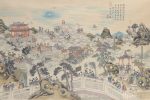
Analysis: The Celestial Scene (The Realm of Immortals)
Subject: This painting depicts a Daoist Paradise, likely the dwelling of the Queen Mother of the West (the Yaochi or “Lake of Gems”).
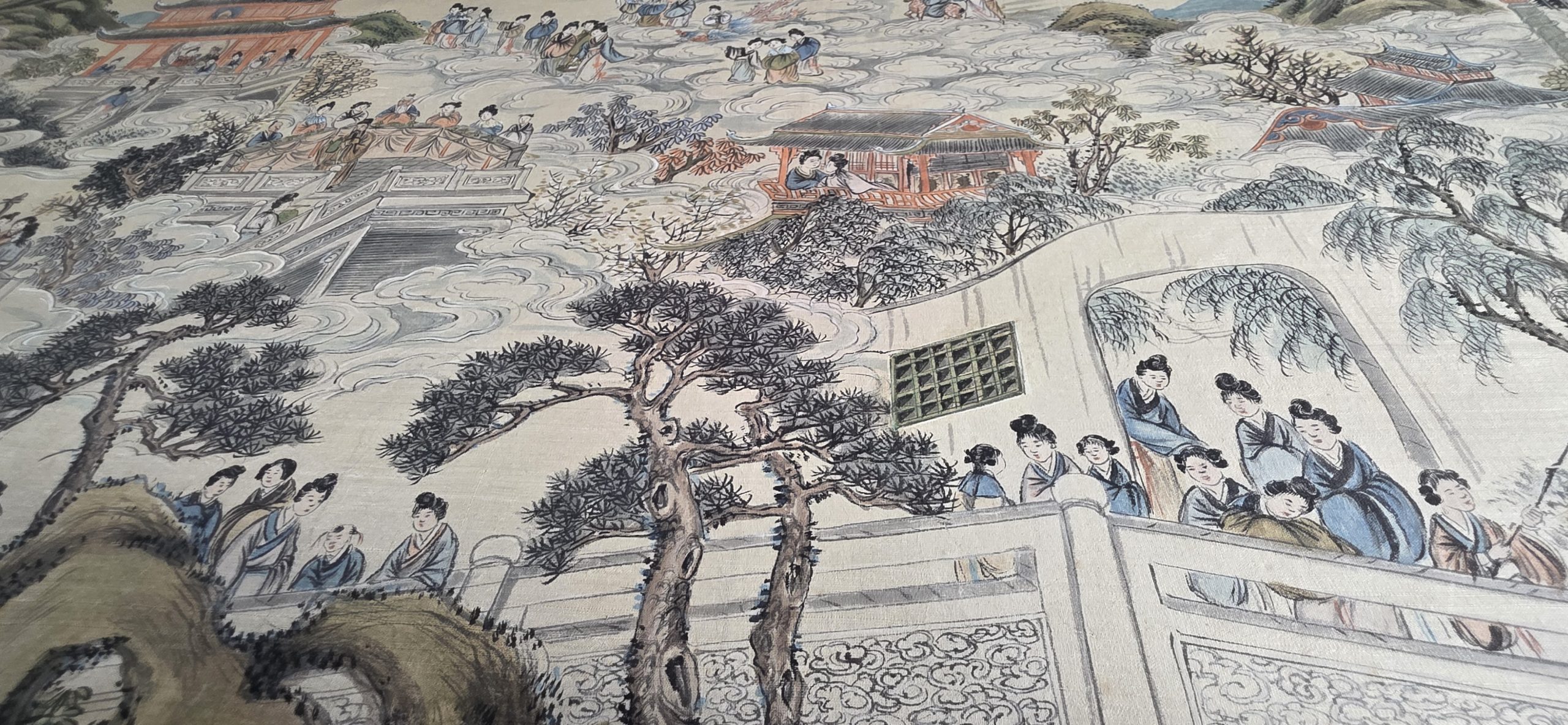
- The Narrative:
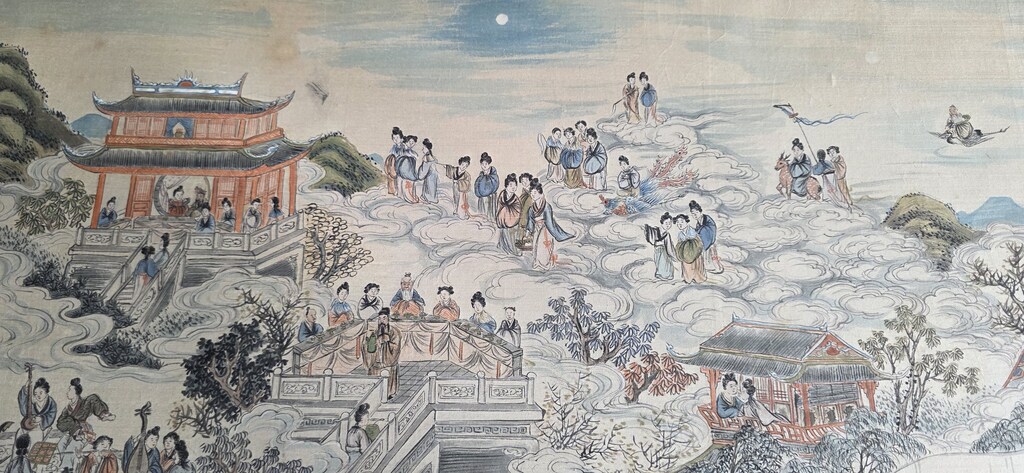
- The Setting: The scene takes place high above the mortal world. Notice how the ground is not dirt, but swirling clouds and mist. The architecture consists of “Gold and Silver Palaces”—elaborate pavilions with red columns and sweeping tiled roofs.
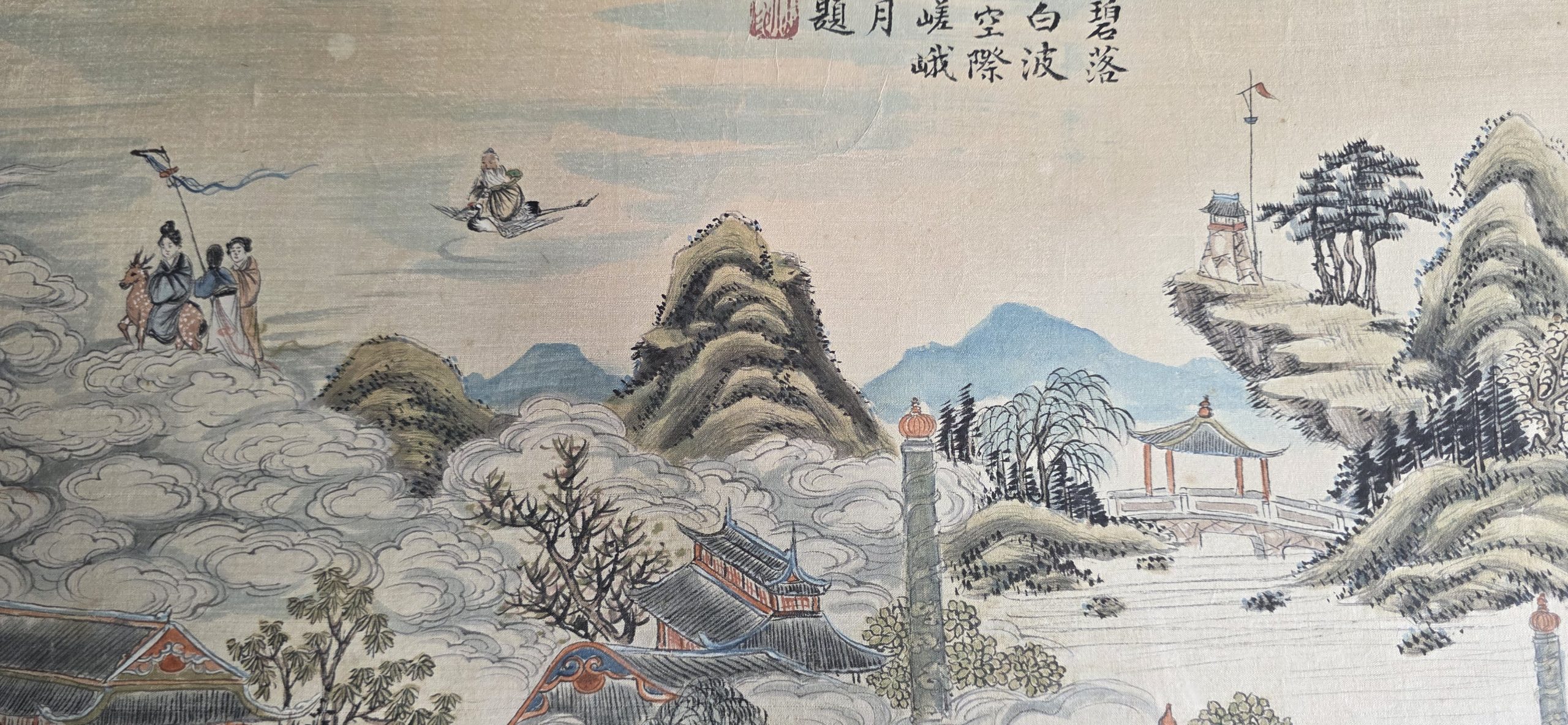
- The Phoenix Rider: In the upper right sky, a figure is riding on the back of a Phoenix (Fenghuang). This is a classic symbol of an immortal descending from the heavens.
- The Procession: A long line of elegant female figures (fairies or immortals) winds through the clouds. They carry banners and ceremonial fans, suggesting they are greeting a high-ranking deity.
- Music and Leisure: On the left terrace, a group of musicians plays the pipa (lute) and flute. On the right, figures gather in a pavilion to chat, while others cross a marble bridge over a celestial pond.
- The Poem (Top Right):
- The poem describes “riding a phoenix to the azure sky” and mentions seeing “gold and silver palaces” shimmering in the void. It captures the ethereal, dreamlike quality of the scene.
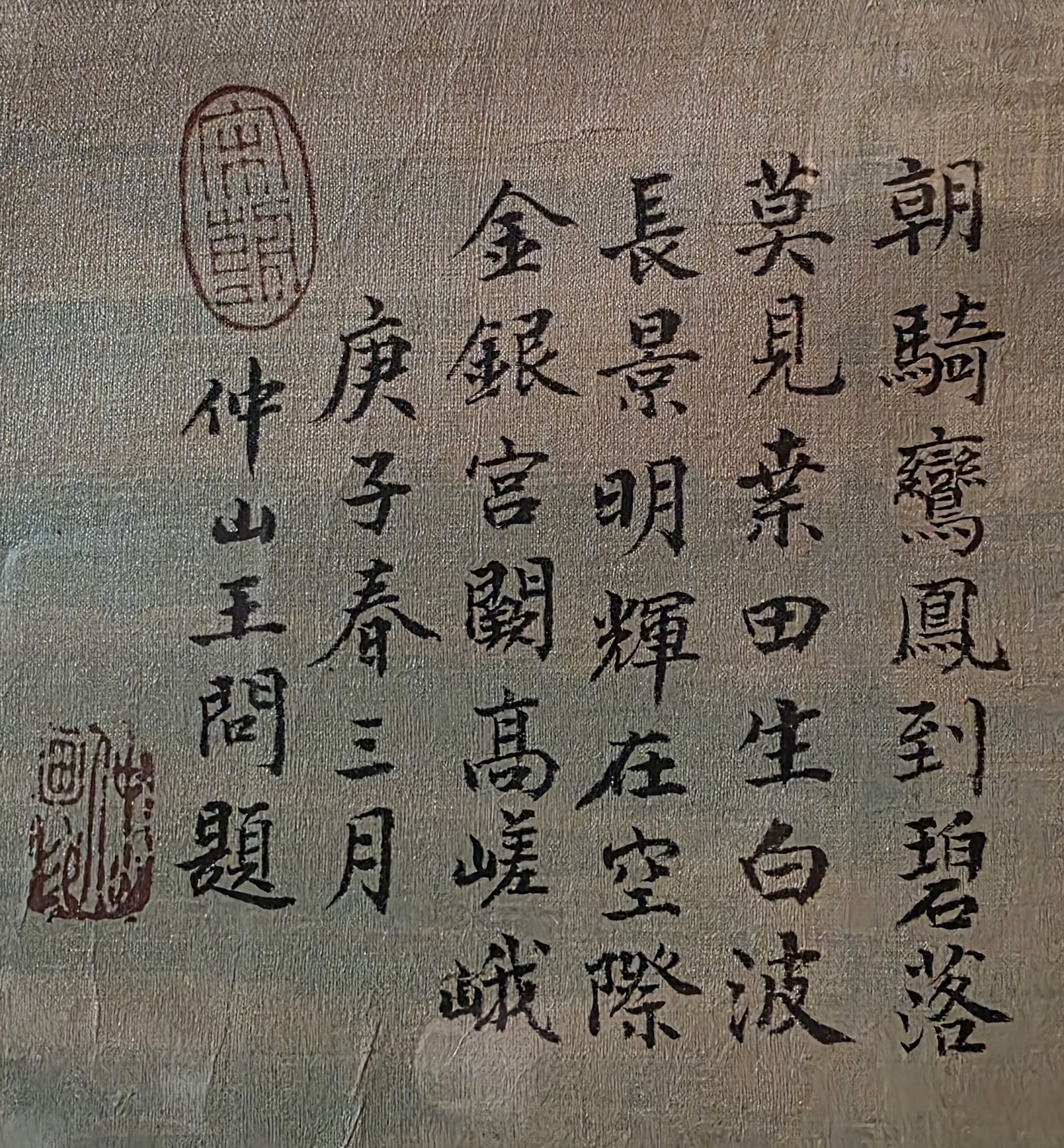
"At dawn, like the morning dew, the spirit rises suddenly to the Azure Heights.
Do not dwell upon the great transformation of the earthly realm, or the white waves of cloud and mist.
The eternal radiance shines clearly at the farthest edge of the heavens,
Where golden and silver palace towers stand high and magnificent."
Analysis: The Hunting Scene (The Autumn Hunt)
Subject: This painting depicts an Imperial Hunting Procession, a favorite theme in Chinese art symbolizing the ruler’s control over nature and military readiness.
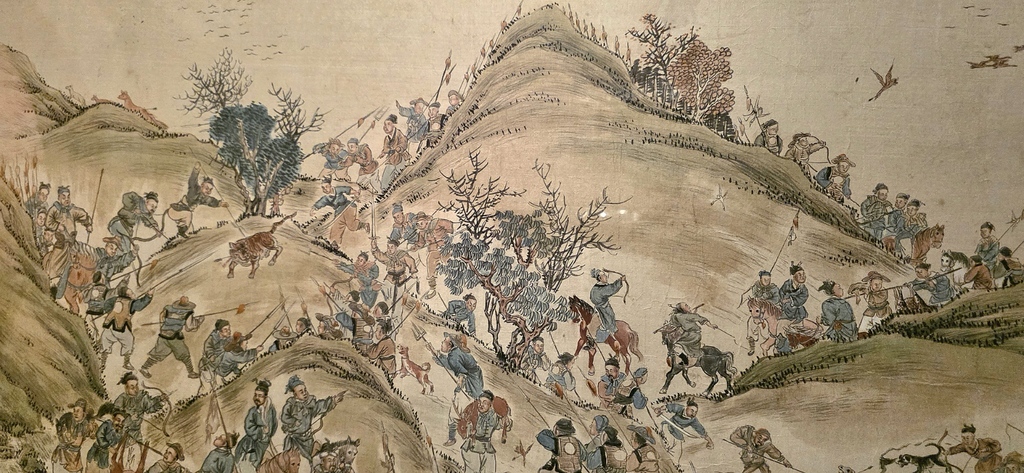
- The Narrative:
- The Landscape: Unlike the clouds of the first painting, this landscape is rugged and solid, featuring rolling hills, sparse trees, and earth tones.
- The Action: The scene is dynamic.
- Centre Left: A group of archers on horseback has encircled a tiger. One archer draws his bow, ready to strike. The tiger is painted with stripes, looking cornered.
- Bottom Centre: The main procession moves forward. You can see the variety of the “army”—some are mounted commanders, while others are foot soldiers carrying flags and spears.
- The Catch: In the bottom left, two figures on foot are carrying a captured deer (or similar game) on a pole, showing the success of the hunt.
- The Details: Notice the hunting dogs running alongside the horses. The figures are dressed in tunics and trousers suitable for riding, contrasting with the flowing robes of the celestial figures in the other painting.
- The Poem (Top Right):
- The text refers to “soldiers guarding the borders” and “painting the harvest of the hunt.” It grounds the image in the reality of human effort and duty.
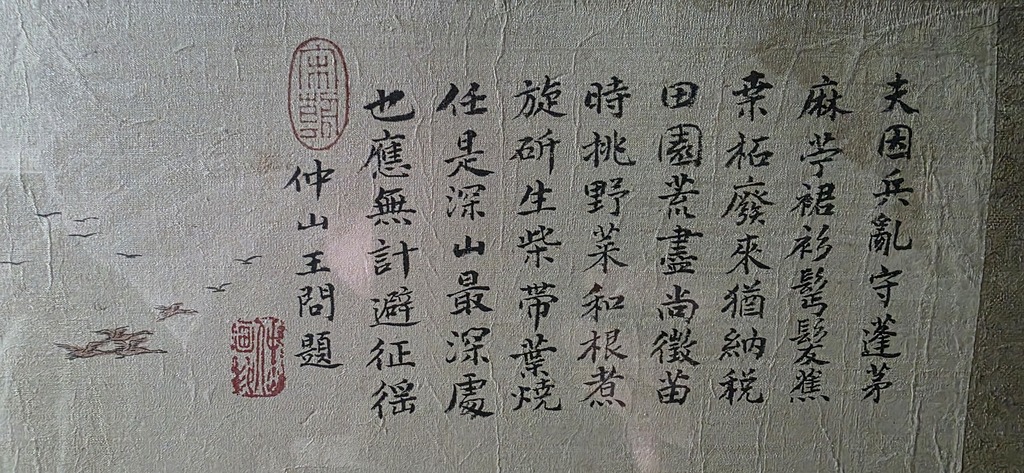
"Trapped by the chaos of war, I tend to my humble, thatched hut.
With the mulberry groves lying fallow, I pay my tax in silkworm bark.
My fields are mostly overgrown, yet still bear a few small sprouts.
From time to time, I pick wild vegetables and boil them, root and all.
In a cycle of labor, I grind raw firewood and burn it with medicinal herbs.
Though I live in the mountain’s deepest recess,I know there is no escape from official levy and forced labour."
Collectors View
These are excellent examples of “Gongbi” (Meticulous Brushwork) style from the end of the 19th century. While they are ‘not Ming Dynasty originals‘, they are antique works of art (over 130 years old) with significant decorative value. They were likely created for a wealthy household to display the twin virtues of Cultural Refinement (the Celestial) and Martial Virtue (the Hunt).
Interpretation Summary
This translation confirms the sophisticated nature of the artwork pair:
- The Contrast: The two inscriptions perfectly mirror the visual content.
- (The Hunt), despite showing power, is paired with a poem about suffering, taxes, and chaos (Shàng zhēng miáo / wú jì bì zhēng yáo).
- (The Immortals) is paired with a poem about eternal, unchanging paradise (Lúanfèng dào bìluò / Jīnyín gōngquè). This contrast is a key feature of traditional Chinese art.
- The Dating: The second inscription explicitly dates the completion of the work to April 1900.
Original Text: ~ 仇英(傳)戰役圖 宮宇仙人圖 設色絹本 鏡框〈一〉款識:夫因兵亂守蓬茅,麻苧裙衫髩髮蕉。桑柘廢來猶納稅,田園荒後尚徵苗。時挑野菜和根煮,旋斫生柴帶葉燒。任是深山更深處,也應無計避徵徭。仲山王問題。實父仇英製。鈴印:「宋朝」「仲山畫印」「十州」〈二〉款識:朝騎鸞鳳到碧落,莫見桑田生白波,長景明輝在空際,金銀宮闕高嵯峨。庚子春三月。仲山王問題。實父仇英製。鈴印:「宋朝」「仲山畫印」「十州」